
|
Lesson: 40 |
|
|
In Limit Hold ’em, it is not uncommon to see pots that are contested by four, five, or even six players. This happens with some frequency at lower limits, especially when playing with those who haven’t learned the virtues of a tight-aggressive style of play. In multi-way pots, draws become especially powerful, and playing big draws aggressively against multiple opponents can create very profitable situations. For example, say that you’re dealt As-8s on the button. Three players limp before the action gets to you, and you decide to limp as well. Both blinds call, so a total of six players see the flop of 4s-7s-Jc. You have no hand at the moment, but you do have the nut flush draw. On the flop, the small blind bets and three players call. What’s your best action? Clearly, folding would be wrong. With two cards to come and nine outs, you’ll make the nut flush roughly 35 percent of the time, making you only a 2:1 dog. With six small bets going in the pot pre-flop and four going in on the flop, you’re getting pot odds of 10:1. You might be tempted to just call and see what the turn brings but, in fact, raising in this situation gives you better value. The pot is getting large and it’s likely that all your opponents are going to call. Even those who have nothing more than second pair or a gutshot straight draw may feel that their pot odds are favorable enough to justify calling the second bet. If your raise gets called by four people, you’ll be getting great value. You’d be getting 4:1 on your money when you’re only a 2:1 underdog – a clear win for you. The raise might also work well for you on the turn and river. By acting after the flop, there’s a chance that the other players will check to you on the turn. This gives you the option of checking and taking a free card if you don’t make your flush. The level of aggression that you show with a draw will largely depend on your position. To show how your play might change with position, imagine you’re in a hand with the same hole cards (As-8s), the same number of players (six), and the same flop (4s-7s-Jc). This time, however, you’re not on the button but are in the big blind instead when the small blind bets out. Here, you want to encourage the other players in the hand to put as much money in the pot as possible. If you raise, you’re probably going to force players with second pair or a gutshot to fold, so your best option is to call. Give your opponents every opportunity to throw money in the pot. Finally, let’s look at how you might play the same cards when you’re the first to act. If you have a nut flush draw in the small blind and there are six players in the pot, go ahead and bet. It’s a favorable situation for you, so you want to make sure that some money goes in the pot. When out of position, I’ll usually follow-up my flop bet with another bet on the turn no matter what card hits. Then, if I miss again on the river, I can decide whether or not I want to bluff at the pot. If I’m against only one or two players on the river, I’ll usually bluff. If there are five players left in the hand, I won’t bother. It’s too likely that someone will call. You can make a lot of money playing draws in low-limit Hold ’em. Just remember that you want as many people contributing to the pot as is possible, which means that in different positions, you’ll need to do different things to get the most out of your draws.
|
|
|
Lesson: 39 |
|
|
In the 18 months that I’ve been playing poker at Full Tilt Poker, the one question I am asked most often is a variation on the following: “Hey Paul? What are you doing in this $10-$20 No-Limit game? Ivey, J-dags, and Matusow are at the $25-$50 No-Limit table, and E-dog is playing in the $50-$100 Limit game. Why don’t you join them?” The first thing I do when I walk into a poker room is put my name on the lists of games I’m interested in; the next thing I do is have a good look at the particular games I’ve just signed up for. More often than not, I’ll sit at the first available table when my name is called, but I immediately take stock of the game and behave accordingly. Often times, everything is just fine, but sometimes I’ll ask to be added to the table change list. Other times, a seat change button is enough to make the game palatable. On rare occasions, I simply leave the table. As I play, I take note of the loose players and tight players, and then use that information to decide which seat will be most profitable. Likewise, I keep a casual eye on the other games. If I get called for a table change, I make sure the new game is the more lucrative one; if it’s not, I’ll stay put and ask to be put at the bottom of the transfer list. And while I have seen unbeatable $3-$6 games and very soft $10-$20 games running side by side, it’s safe to assume that higher limits mean tougher games. If you’re playing to learn, nothing will challenge your poker skills like being at a table with Howard Lederer and Phil Gordon. If you’re playing poker for entertainment and making money isn’t your goal, by all means choose your tables according to where you’ll have the most fun. But if your only goal is to make money, forget about everything except picking the weakest game at a limit you can afford, even if it’s the $1-$2 game when you’re itching to play $2-$4. In ring game poker, it is better to play smaller at the table you’re likely to beat than it is to play bigger at a tougher table. You also need to take your time about moving up a level. I have seen many $1-$2 players sustain steady win rates at those stakes for a month, then disappear for weeks after taking a shot at the $2-$4 game. Knowing where to play is as important as knowing how to play. If you pay close attention to your game selection, you’ll grow the kind of bankroll that will allow you to have more games to choose from.
|
|
|
Lesson: 38 |
|
|
Stud-8 or Better is a great game. The rules are nearly identical to regular 7-Card Stud, but there’s one key difference. At showdown, the pot is split; half is given to the player with the best high, and half to the player with the best low. In order to take a portion of the pot, a low hand must have no card higher than an 8. If there is no qualifying low, the high hand takes the entire pot. With players aiming for both high and low hands, Stud-8 invites a lot of action. But beginning players, even those with some 7-Card Stud experience, often come to a Stud-8 table with a poor understanding of what hands do well in this split-pot game. To understand what types of hands you should play in Stud-8, you must grasp this key concept: In Stud-8, you’re looking to scoop pots. By scoop, I mean that you want to take both the high and the low halves of the pot. That’s where you’re going to make your real profit. The starting hands that are most likely to make you the sole winner of a big pot contain three low suited connectors. For example, As-2s-3s and 4h-5h-6h have great potential. They’ll often make unbeatable lows and have a flush or a straight to go along with them. So, if you see a hand that starts with three low suited cards, look to play it aggressively. You should play hands with three low cards, especially those that include an Ace. A starting hand like Ac-2d-7c may not have potential to make a flush, but there is a good chance that you’ll create a solid low. And the Ace gives you a shot at a decent high, with something like Aces-up. Even a hand like 4-5-7 has enough of an opportunity to make both straights and lows to make it playable. The major mistake that new Stud-8 players make is that they play aggressively with hands that might serve them well in a regular game of 7-Card Stud. For instance, a hand like T-J-Q plays well when you only need to be concerned about creating a high hand. But in Stud-8, this is a hand that should be mucked. With no chance of making a low, a player could find himself chasing a draw that would only net half the pot. Those sorts of situations will often lead to dreadful results. Big pairs, like Jacks, Queens and Kings, are also difficult to play in Stud-8. A quick example will illustrate the problem big pairs present. Say you’re dealt a Queen and a 7 in the hole, and another Queen as your up-card, giving you a pair. After the betting on third street, two other players remain, one showing a 5, the other a 3. This appears to be a good situation for you, as the other two seem to be looking for lows. But then, on fourth street, the player who had a 3 catches an Ace and you find a 9. Now you’re in a very difficult spot. The Ace might have helped your opponent’s low draw and perhaps added a straight draw to his hand. Or it might have paired an Ace he had in the hole. It would be difficult to know where you stand. Even if you were ahead, you need to be concerned that your opponent will pair the Ace or hit a straight before the end of the hand. If you’re going to play big pairs in Stud-8, proceed with caution. Be ready to dump the hand if one or more of your opponents develop a scary board. The later streets in Stud-8 can be lot of fun as players try to figure out how their opponents’ hands are developing. It takes practice and experience to become a good Stud-8 player. But if you follow the suggestions for starting hands I discussed here, you should be on your way to playing Stud-8 profitably.
|
|
|
Lesson: 37 |
|
|
Most players know that pre-flop position is important in hold ’em. The earlier your position, the more players there are behind you and, unless you hold pocket Aces, the bigger the chance that one of them will have a hand better than yours. There is another aspect to position: It’s better to act after your opponent(s) rather than before. But for this tip, I’m going to investigate the chances that a player behind you will have a better hand. There is no universal definition of what “better” means when comparing hold ’em starting hands. For this article, I needed some reasonable, quantifiable criterion. So in the following, I’m assuming that one hand is “better” than another if its showdown equity is greater. A hand’s showdown equity against another hand is the average portion of the pot it will win across all possible combinations of board cards. This is similar to the percentages that TV poker programs display next to player hands when the players are all-in. If you’re interested in investigating this for yourself, there are several free computer programs and websites which calculate the showdown equities of user-specified competing hands. For example, Ah 2d all-in pre-flop against Kc Qc will, over all possible boards, win an average of 53.9% of the pot. So the A-2 is the “better” hand against K-Q suited by our definition. Obviously, it is not better for all purposes; at a full table I’d usually open-raise in early position with K-Q suited, but toss A-2 offsuit. Given some specific hand category – such as K-Q suited – we’ll need to know the chance that a random hand dealt from the remaining 50 cards will be “better.” This requires that we have a showdown equity calculation for each of the 1,225 possible opposing hands and tabulate against how many of them the K-Q suited has the worse (less than 50%) equity. It turns out that 238 of the 1,225 possible opponent hands are “better” in this sense. So we say that the chance of a random hand being better than K-Q suited is 238/1,225 or 19.4%; conversely, the chance that a random hand will not be better is 80.6%. This tabulation would be too tedious to do by hand. For the example results below, I developed some simple software to do the calculations. Suppose that you are considering an opening bet pre-flop. There are players yet to act behind you. I’ll denote the number of hands to play behind you as N. For example, if you’re on the button, then there are two hands – the blinds – behind you, and N would be equal to 2. What is the probability that none of some number of random hands will be better than yours? It is the chance that one random hand will not be better than yours multiplied by itself N-1 times, which is the same as saying it’s that probability raised to the Nth power. For example, if there’s a 40% chance that a random hand won’t be better (i.e., a 60% chance it will be better), then the chance that none of three random hands will be better is 40% x 40% x 40%, or 0.4 to the 3rd power, which equals 0.064. Hence, the chance that at least one of the three hands will be better is 1.0 – 0.064 or 0.936 or 94%.
I think the most interesting thing about these numbers is the difference between earlier and later positions. This is something to consider when you’re thinking of open-raising in early position.
|
|
|
Lesson: 36 |
|
|
I often tell people that short-term results are not a reason to change how they play, but I likewise encourage them to use any excuse to study and analyze their game. Recently, a player on Full Tilt Poker lamented that he’d gone broke with A-K in his last several tourneys, and he suspected that he was doing something wrong. A few questions revealed that he was getting knocked out fairly early in these tournaments when he put his A-K up against pocket pairs for all his chips. It’s a familiar lament. Many people fall in love with A-K pre-flop in No-Limit Hold ’em because they know that they can rarely be much worse than 50-50 to win the hand if they get all of their money in heads up. While this is true, the reverse is also true: Rarely will you be much better than 50-50 to win an all-in showdown. So why is A-K considered such a great starting hand? Folding equity. Under the right conditions, you can increase your pot equity to well over 50% by getting your opponents to fold in situations where they shouldn’t. Here’s a scenario: Blinds are $200-$400 and Jen Harman (who has $12,000 in front of her) raises to $1,200 from middle position with pocket tens. You re-raise all-in for $6,000 with A-K from the button. It is difficult for Jen to call here because, even though she suspects you might have A-K, she knows you could also make that play with A-A, K-K, Q-Q or J-J. Does she want to play for half of her stack on what figures to be, at best, a 57% favorite? You, on the other hand, are confident that unless she has one of two hands (AA or KK), you are no worse than 43% to win, even if she calls. Unless Jen picks up on a tell, she is forced to fold a hand that is actually better than your A-K by a slight margin. Not only that, but you’ve also made her give up all the extra chips in the pot (mostly hers) that were giving her great odds to make a call. Variants of this scenario come up all the time in No-Limit Hold ’em. By putting your opponents in a bind where they must first call you and then have to beat you in a race, you can turn a hand that is 50% to win with all the money in pre-flop and turn it into a hand that is a 75% favorite or better. The mistake many inexperienced players make is not giving their opponents a chance to fold. They look down to find A-K and can’t wait to get all their money in the middle and race. But as we can see from the example above, the power of A-K pre-flop really comes from the “folding equity” you gain when you can make your opponent lay down a hand they would not lay down if they could see your hole cards. Here are three keys to getting the most out of A-K pre-flop: 1) Jam with A-K, but don’t call all-in with it. 2) Raise enough when you have A-K to give your opponents a chance to fold. 3) Don’t raise so much that the only hands that are willing to call you are the hands that have you dominated (A-A and K-K). To execute these plays properly, it is important to keep in mind the size of the blinds relative to your opponents’ stacks and your own stack. A-K loses much of its value when your opponents are short-stacked or pot committed — and therefore unlikely to lay down a hand — or when the blinds are very small relative to everyone’s stacks. These principles apply to both ring game and tournament play. Getting back to my friend who kept busting early in tourneys with A-K… In the early stages of a tournament, the blinds are very small relative to everyone’s stack size. This contributed to his breaking of each of the three rules: (1) He was calling his opponents’ all-in raises when they had their expected pocket pairs. (2) He was jamming only after his opponents were pot-committed. (3) After getting gun shy from having his A-K cracked a few times, he made his raises way too big to “protect” his hand, but then was only getting called once he was beat. This is one of those instances where looking at short-term results can lead to long-term improvements.
|
|
|
Lesson: 35 |
|
|
Losing is part of poker and all serious players, including the world’s best, can recount losing streaks that lasted for months. Often, the downswing starts with a particularly unlucky run of cards. A series of bad beats or impossibly tough hands eat away at the bankroll. As the bad run continues, and money continues to disappear, players are forced to confront one of the toughest questions in poker: Am I a victim of lousy luck or am I playing poorly? John D’Agostino knows how difficult it is to find the correct answer. “Any time I lose a few sessions in a row, I start questioning myself,” D’Agostino says. “But I know that some days, even if I play perfectly, I’m going to lose.” Erik Seidel notes that in tournament poker, months-long dry spells are to be expected. In the midst of such a run it’s hard to know if you’re a victim of expected fluctuations or if there’s something wrong with your game. “It’s really hard to determine,” says Seidel, “but I think most of us tend to fool ourselves and tend to think we’re playing better than we are.” Then there’s the inevitable interplay between bad cards and poor play. The pros report that in the midst of a bad run, bad luck can lead to bad decisions. Jennifer Harman notes that when things are going poorly, she has a tendency to push hands. “Let’s say I have Ace-King and I don’t flop a pair,” says Harman. “I’ll be in there raising. But there’s no point. My table image is bad and nobody thinks I can flop a hand, so I can’t bluff. I might as well wait till I flop a pair. At that point, my opponents are going to call me down and pay me off anyway.” For D’Agostino, a bad run can lead to more timid play. ‘I definitely made some bad days a lot worse than they needed to be. Sometimes, I started playing more passively. In the middle of a hand I’d be asking myself, ‘How is this going to go wrong?’ But if I played the hand the way I usually would, I’d have won the pot earlier on.” D’Agostino says that when he has that sort of mindset, he’s likely to miss bluffing opportunities. Such a streak can destroy a promising player. Harman says, “There are a lot of players who have gone on losing streaks and can’t recover. They start playing bad and thinking that they’re doomed forever. And all of a sudden, they’re on the rail.” How do the pros get a handle on their play and determine what’s causing the downswing? Harman recommends sharing hands. “I’d ask people to watch me play or I’d jot down hands and ask friends ‘Did I play this right?’ If they said I was playing it wrong, I’d have to reevaluate my play because I was letting the losing streak affect my play.” “Just book a win,” says D’Agostino. He notes that confidence is critical at the poker table. So, in the midst of losing streak, leaving a session with a win – even if it’s a small one – can help a player regain that mental edge. “Once you can feel confident about yourself, things will start to roll,” he says. Finally, a winning player needs to develop an honest, self-critical nature. Seidel notes that he rarely talks poker, but when he and John Junada chat about a play, the conversation usually begins, “Listen to how badly I played this hand.…” When playing online, there’s every opportunity to assess your play. Save your hand histories. When a session is over and your head is clear, review your actions and see if you can spot problems in your play.
|
|
|
Lesson: 34 |
|
|
In last week’s tip, I shared some strategies for playing short-handed no-limit cash games. This week, I’m following up with some more short-handed advice, this time concentrating on Limit Hold ‘em. If you read last week’s tip, you’ll know that hand values change in short-handed play and that it’s proper to play a greater percentage of hands than would be wise at a full ring game. In these games, I play a lot of hands. So many, in fact, I’ve gotten the reputation of being something of a maniac. But there is a method to my madness. By the end of this article, I think you’ll agree. Button Play In a three- or four-handed Limit Hold ‘em cash game, I will raise about two of every three times I have the button. The quality of my hand is essentially irrelevant. The position raise puts me in control of the hand and, even if I’m holding total trash, the pressure puts the blinds in a spot where they need to catch a piece of the flop. For example, say I raise on the button and the big blind calls with a modest but playable hand, maybe Qc-Td. Now, if the flop comes with any Ace or King, the blind is going to have a very difficult time continuing with the hand if he checks and I bet the flop. In fact, the blind is going to have a very difficult time continuing on any board that doesn’t contain a Queen or Ten. If I follow up my raise and bet the flop with, say, 7-high, and get called or check-raised, it’s very easy to lay down the hand. I know this is going to happen at times, but I pick up the pot often enough to make the constant button aggression profitable. Small Blind Play When playing against opponents who raise frequently in position, I’m sure to respond with aggression in the small blind. If I’m holding a hand that’s likely best at a three-handed table – something as modest as A-9 might qualify – and I’m facing a button raise, I take control of the hand and three-bet. That puts additional pressure on the big blind. If I only call the button raise, the big blind will be getting great odds (5:1) to call the additional bet. And I’d far prefer to play the hand heads-up. After three-betting from the small blind, I follow up with a bet on the flop almost 100 percent of the time. Since I represented a big hand pre-flop, I want to put my opponent to a decision immediately. Once I see how my opponent reacts, I can decide how I should proceed with the hand. I’ll have to give it up sometimes, but the pressure will force a lot of folds. Big Blind Play The big blind is the only place where I’m content to call bets pre-flop. In fact, a call is my usual reaction to a button raise. If I start with a moderate hand, I can see the flop and decide how to proceed. If I start with a strong hand, like pocket Aces or Kings, I’ll still call and look to check-raise the flop. I don’t like to three-bet from the big blind because it tends to announce my hand. My opponents know that I’m starting with a very big hand. Overall Goal As you can probably tell by now, I believe that aggression is key to success in short-handed Limit Hold ‘em. I think the constant bets and raises create two dynamics that can be exploited for profit. First, by being the aggressor, I have the opportunity to pick up a number of pots where both my opponent and I miss the flop. Second, the aggression has the tendency to lead opponents to make some very bad decisions. After some time, opponents may call bets on every street with nothing more than Ace- or King-high. When they start doing that, I can tighten up and only bet hands that are likely to be winners at showdown. At times my style may look maniacal. But in short-handed limit play, it works.
|
|
|
Lesson: 33 |
|
|
Let’s face it; nobody takes up poker because they love the idea of sitting idly at a table while folding for hours on end. But, in a full ring game with eight or nine other players holding cards, it’s proper to spend most of your time folding because there’s too great a chance that one of your opponents holds a powerful hand. But, in short-handed play when only three or four people have cards, you’re forced to open up. With the blinds coming around so frequently, you need to be playing and winning a number of pots just to stay even. And, with only a couple of opponents, you can be less concerned about running into a big starting hand. On most deals, everyone’s holding trash. Here’s some advice for altering your strategy for short-handed no-limit cash games. Keep in mind that all the advice here is geared toward short-handed play while players have deep stacks. The advice given here won’t work especially well in a tournament, or against players who come in with less than 100 times the big blind. My love of short-handed play is one of the reasons I play online so much. It’s rare to find a three- or four-handed table in a casino, but online, I can find short-handed games any time I want. Pre-Flop Strategy Three- or four-handed games are usually very aggressive, and I will never limp in. I open-raise or I fold. In a typical short-handed game, I’m raising one in every three or four hands when I’m not in the blinds. I recommend raising with every hand you’d raise with in a full ring game (big pair, AK, AQ). In addition, I raise with any pocket pair, including twos and threes. I’ll also raise with suited-connectors, such as 4s-5s. What might be something of a surprise is that I’m extremely wary of hands that seem to hold some promise. Hands like A-J, A-T and K-J, are hands that most know to treat cautiously in a full ring game, but I will often fold these in a short-handed game as well. Why? Well, these are hands that are likely to get me in a lot of trouble. For example, if I were to raise with K-J, and the flop came K-T-3, I’m either going to win a small pot, after betting my top pair and seeing my opponents fold, or I’m going to lose a much larger pot as my decent hand goes down in flames against two-pair, a set, or an out-kicked top-pair. It’s also important to note that A-J, A-T are just about useless against re-raises and must be mucked against most opponents. With a hand like 4s-5s, however, I can call a re-raise with hopes of catching a big flop (two-pair, trips) or a big draw, and then taking my opponents entire stack when I hit. If I miss a flop with a suited connector or manage to hit only bottom pair, I can easily fold to a flop bet. But if I call a re-raise with A-T and then catch top pair on a Ten-high flop, I may get in real trouble against a bigger pair. Or if I flop an Ace, I could be out-kicked. Post-Flop Strategy If a pre-flop raise from the cutoff or button has been called by one of the blinds, it’s important to make the most of your positional advantage. Keep in mind that in a short-handed game, your opponent isn’t likely to hold much of a hand and that even if he held something decent, chances are he missed the flop. (In hold ’em, unpaired hole cards will fail to make a pair on the flop about two-thirds of the time.) So, if I missed the flop completely while holding something like 6-high, I’ll almost always bet the flop. If I get called or check-raised, I’ll happily shut down. But, I pick the pot up often enough to make the bet in this situation worthwhile. If, however, I’m holding a decent Ace and miss the flop, I’ll usually check. In a short-handed game, Ace-high can win at showdown, and taking a free card gives me a chance to hit my hand on the turn. I’ll also bet most of my draws on the flop. Often, I’ll win the pot with a bet. Even if I’m called, I’ve got the added benefit of building a large pot. If I happened to hit my draw on the turn or the river, there’s a good chance I’m going to take my opponent’s stack. Psychological Strategy Short-handed play takes some getting used to. The pace is furious, forcing a lot of tough decisions in very short periods of time. The swings are far more dramatic than in a full ring game but, I think that after adjusting to the pace of the action, most players will come to love the excitement that accompanies short-handed play.
|
|
|
Lesson: 32 |
|
|
This past summer, I had the good fortune to cover the World Series of Poker for PokerWire.com and Full Tilt Poker. For six weeks, I watched world-class players ply their trade and, in that time, I learned a ton about poker. What follows are three lessons I learned from watching Full Tilt Poker’s pros during their long days of play. Never Rush a Big Decision Even in the top ranks of poker, there’s a tendency among players to act rashly and blurt out an action – “All in!” or “I call!” – without having taken nearly enough time to carefully consider the situation. Of course, a player shouldn’t delay while holding the nuts. But I was often surprised to see the time the pros took to mull over situations that seemed to have only one clear-cut action. One of the best examples of this came in the final hand of the WSOP’s first event. Allen Cunningham was heads-up with Scott Fischman. Fischman bet the flop of T-6-3 and Cunningham raised. Fischman called, then checked the turn, a 4. Cunningham made an aggressive bet, but Fischman then quickly check-raised all-in. Cunningham stopped and thought. He had two-pair, 3s and 6s – a hand that usually requires a call in heads-up play. But, he didn’t rush the decision. After a few minutes of thought, he called. When Fischman showed 4-5, it was clear that Cunningham made the right choice. The river, an Ace, gave Cunningham the pot and the bracelet. I was impressed that after 13 hours and 300 hands of play, Cunningham didn’t automatically put his faith in a fairly big hand. He took the time to stop and review the conditions in their entirety. This sort of thoroughness is one reason the pros are less likely to make big, costly mistakes. Never Talk During Play In one of the early WSOP tournaments, Mike Matusow was playing very aggressively. He had a huge stack and used it to bully the table. In one early orbit, he raised on the button. The big blind re-raised all-in. Mike had spent most of day chatting up the table. He turned to the man and asked, “You gotta hand?” The man replied, “Best hand I’ve seen in hours.” “Best hand in hours,” Matusow echoed, “That means you don’t have Aces… I only have King-five, but I think I have to call.” And Matusow was absolutely right. The big blind had pocket 10s, and given the size of the pot, Matusow correctly determined that with one over-card, he was getting the right price to call the bet. Through a seemingly vague and innocuous statement, the big blind had given Matusow vital information, which he was able to use to make the best possible decision. The lesson here; when playing, keep your mouth shut and don’t do your opposition any favors. Bet Your Hand The great players – Phil Ivey, Erik Seidel, Chris Ferguson, etc. – usually err on the side of aggression. That is, they sometimes find themselves betting with hands that are underdogs to win. But, in my time at the WSOP, I can’t remember a time when I saw a top pro miss a bet in a vital situation. By contrast, many novice players in this year’s WSOP seemed determined to check-raise or slow play their hands. They were trying to be tricky. But often, their failure to bet was disastrous. Opponents were permitted to check down hands with which they might have called bets, and others were allowed to draw for free. The best players are aggressive, and by following their lead, you’re less likely to make mistakes that could cost you valuable chips. We’ve all heard that poker is a game of skill rather than luck, and watching the top pros play – either live or on television – only proves the truth of that statement. Watch how they act at the poker table, and it quickly becomes clear why the same players consistently finish in the money. Follow their examples, and it’s a good bet that you’ll pick up a few tips that can improve your game.
|
|
|
Lesson: 31 |
|
|
You are in the big blind with Ts-8s against a player who smooth-called pre-flop. The flop comes K-X-X with two spades. What do you do? You would like to make your flush, and you don’t want to pay too much to get there. Instinctively, you think checking is the best way to get a free card, and you’re right. In fact, checking is the only way to get a free card, but it may not give you the best opportunity to make your hand, nor will it pay you maximum value when you make the flush. Suppose your opponent bets the pot. Now you’re getting 2-1 to call for a 4-1 chance of making your hand. You don’t even get to see the turn card. You’ve been priced out. What happens if you lead out with a small bet? If you’re against a player who likes to slow play or a player who will bluff you out with a big bet, a small bet gives you the best chance of seeing the turn. How small is a small bet? Try betting between 1/3 and 1/4 of the pot. If there is $300 in the pot and you bet $100, you are now getting the right price to make your flush. If you bet $75, you are now getting better than pot odds, and this doesn’t account for your implied odds, which take into account the amount of money your opponent will bet or call on the turn and river. If you make your flush on the turn, and your opponent is willing to call your $400 bet, you are getting implied odds of $300 (current pot size on the flop) + $400 (expected amount your opponent will call on the turn) = $700 to $100 (your bet on the flop), or 7-1. This is an even better play when your drawing hand is less obvious. Suppose the flop is Q-9-6. Now you are drawing to the double gut shot straight, where a 7 or a J makes your hand. While an 8 or a K is an obvious scare card, a 7 looks like a card unlikely to have helped anyone. (The risk factor here is that the J might give you the “idiot end” of the straight against an opponent holding K-J, and your 1/4 pot bet is exactly the right price for him to call.) In a tournament, this type of drawing strategy can become a riskier and less profitable play, especially early on. Because you start with a limited number of chips in tournament play, your odds need to be closer to 5-1 or even 6-1 before you should consider risking them on a draw, and potentially leaving yourself short stacked. The important thing when drawing is to be the aggressor. Losing initiative leaves you vulnerable to being priced out of the pot, whether it’s by a made hand or a bluff. If you want to see another card at the right price, your best bet is to be the bettor.
|
|
|
Lesson: 30 |
|
|
In the premier episode of our new show, “FullTiltPoker.Net Presents Learn from the Pros” broadcast on FOX Sports Net, five of our pros engaged in a roundtable discussion about stepping up in limits. Everyone agreed that one of the best ways to improve your game is to play against better players. Jennifer Harman said she faced more tough decisions at her first table with Doyle Brunson than she’d faced in all her previous years of playing poker. Layne Flack and Howard Lederer agreed that the constant pressure can be a good thing, forcing you to weigh each decision more carefully and rethink old habits and patterns. Chris “Jesus” Ferguson said his best learning opportunities come at World Series final tables, and Phil Ivey remarked that, with time, you start to look forward to playing out of your comfort zone. Perhaps the adrenaline helps keep you focused. But maybe there’s a corollary to this; the idea that being a first-timer relieves you of the pressure that can only come from having already had a taste of victory. It’s true that you see a lot of the same names winning tournaments, but some newcomers have had some incredible finishes, and many of today’s pros started out with very early success. Erik Seidel finished second to Johnny Chan in his very first World Series of Poker Main Event. Andy Bloch won the first No-Limit Hold ’em event he ever entered. Phil Gordon finished fourth in his first WSOP Big Dance. And Howard Lederer has made the final table of the World Series of Poker Main Event just once – the first year he entered the event. When Howard survived to Day 4 in 2003, he made this observation: I am playing for more money than I ever have, and this kind of chance at the WSOP will probably only come up for me a few more times in my life. But, for some reason, I am only thinking about this table, this hand, this moment. I have read some Zen Buddhism in the last few years and it is really helping me now. In particular “Zen and the Art of Archery”, a short little book, has everything you need to know about staying in the moment. Thinking about the recent past or the possible future at moments like these can only hurt your ability to make the plays necessary to win. And, those thoughts can actually make it impossible to win. I have started to think that players like Varkonyi and Moneymaker have an advantage over experienced tournament players. Yes they would like to win, and they know this is an important tournament, but they don’t feel that importance deep in their bones like a seasoned pro who has been trying to win the WSOP for years. It frees them up to play their best when it matters. My best finish was in my first try. It wasn’t real to me. I remember having a great time, and not feeling a lot of pressure. Getting back to the roundtable… everyone agreed that tournaments are a good way to get out of your comfort zone without risking your bankroll. Try to let inexperience work for you, not against you. If you’re at your first final table and you see enough bracelets to fill a Tiffany display window, use it as a learning opportunity. Also use it as a chance to enjoy the moment and focus on the here and now. You don’t yet have a past, and living in the moment is the best way to ensure you have a future.
|
|
|
Lesson: 29 |
|
|
When I’m thinking about my actions after the flop or turn, I look to the “texture” of the board – i.e., what cards are in play, and how might they interact with my opponent’s likely starting hands – to help determine if and how much I will bet. My normal post-flop betting range is one third of the pot to the full size of the pot. The texture of the board dictates where in that range I choose to bet, and I determine that based on the following four factors: 1. How strong is my hand with respect to all of the likely hands for my opponent? If I have a very strong hand with respect to all of the likely starting hands for my opponent, I’ll usually go for the lower end of the spectrum, betting around 1/3 of the pot. I want my opponent to call. If I have a moderate strength hand with respect to all of the likely starting hands for my opponent, I’ll likely bet 2/3 of the pot. I want my opponents to fold some hands that are better than my hand and call with some hands that are worse than my hand. If I have a weak hand with respect to all of the likely starting hands for my opponent and I want to bet, I’ll bet the pot. I want my opponents to fold hands that are better than my hand. 2. How likely is my hand to improve? If my hand is unlikely to improve, I tend to bet more than 2/3 of the pot. I want to take this pot now. If my hand is somewhat likely to improve, say about 15% to 20% of the time, I am more apt to bet 2/3 of the pot. If my hand is very likely to improve (about 34% of the time or more), I am more apt to bet 1/2 of the pot. 3. How likely is my opponent to have “hit the flop” and have a pair or better? If my opponent is unlikely to have hit the flop and have top pair or better, I tend to bet 1/3 of the pot whether I think I have the best hand or not. If my opponent is likely to have flopped exactly one pair, and I think I have the best hand, I tend to bet 2/3 of the pot. If my opponent is likely to have flopped two pair or better and I think I have the best hand, I tend to bet the size of the pot. If I don’t think I have the best hand, I’ll almost never bet. 4. How likely is my opponent to have a primary draw? (That is, a draw to the best possible hand on the board, like a straight or a flush.) If I think my opponent is likely to have a primary draw and I think I have the best hand, I’m likely to bet the size of the pot. If I think my opponent has a primary draw and there is a good chance I don’t have the best hand, I’ll almost never bet. When the four factors above lead to different conclusions about how much to bet, I average the recommendations and bet that amount. Over time, you’ll develop a more immediate sense of the “texture” of the board, and the amount to bet based on that will become almost automatic. Then, you can spend less time calculating your actions and more time observing your opponents. This lesson is from Phil Gordon’s Little Green Book: Lessons and Teachings in No Limit Texas Hold’em , published by Simon Spotlight Entertainment.
|
|
|
Lesson: 28 |
|
|
I was at my first World Series of Poker in 2002, talking to a player who had made the final table the year before. He told me something I’ve never forgotten, and it’s helped me ever since. I had raised pre-flop with A-K and he called from the button. The flop came all small cards. I checked and he fired a pot-sized bet. I looked at him and said, “You must have a good hand.” His reply caught me off guard; “It doesn’t matter what cards I have if I know what cards you have.” At first I thought I might have a tell – maybe I hummed when I missed the flop, or I looked away from my chips. It was later that I realized I did have a tell, but it had nothing to do with my physical demeanor. It was the way I played my cards. Poker is often not so much about the cards you have, but knowing the way your opponent plays. Keeping track of which hands your opponent raises with – and the position from which he raises with them – is a large part of the game. In a live game, it is hard to remember exactly what cards your opponent has raised with over the years and, if they’re good players, those hands will change from time to time. But many poker players are creatures of habit, playing the style they are most familiar with. Online, there is no excuse not to have this knowledge at your fingertips. While playing on Full Tilt Poker, I get to write notes on players and it is a great help. I am always referencing my notes, and they will often tell me which hands an opponent has played in the past. The color-coding makes it even easier for me. I use one color to mark the players who only bet when they have a strong hand, and another color to mark the action players. When I see a player marked with a certain color, I can safely assume that he’s going to overplay his hands. This is a guy I am more willing to call with a hand that might be a little weaker, or a drawing hand after the flop. Why? Because I know that if I hit my hand, he’s going to pay me off; I have implied odds to call. With another player, I’ll play a little tighter because not getting paid off means my implied odds aren’t there. This one bit of information has both increased my winnings and minimized my losses. Self-awareness is an important part of any endeavor. But in poker, knowing your opponent is just as important as knowing yourself.
|
|
|
Lesson: 27 |
|
|
While playing on Full Tilt Poker, I have said that there are three topics I won’t discuss in table chat; politics, religion, and whether online poker is rigged. That’s because many people’s opinions on those topics are hardened and not amenable to friendly or productive discussion. Away from the table, I’ll venture a couple of comments about improbable events in poker. While not direct instruction in the tactics and strategy of play, these comments may help you take “bad beats” in stride — and that, in turn, is an essential part of poker maturity. First, let’s consider what most would view as a typical “bad beat” — a lower pocket pair winning against a higher pocket pair in hold ’em, such as KK beating AA. When those hands share one suit, the chance of the worse hand winning is about 18%. The chance of the lower pair winning twice — that is, the next two times that such hands happen to go against each other — is about 3%. If in one session of play, a lower pocket pair beat a higher pocket pair twice, that might seem a little, well, weird to some players. Consider another situation involving chance. When two dice are thrown, the chance of rolling “snake eyes” (1-1) is about 3% — about the same as a lower pocket pair beating a higher pocket pair twice. Suppose there were 600 craps tables using standard, unaltered dice with nine players around each table — a total of 5,400 players — and these tables operated for a three-hour “session.” How many players would observe snake eyes being thrown at least once? The statistical expectation result is not important. The point is that it’s easy to intuitively see that a large number of players would. Further, do you think some players might see snake eyes thrown several times in an evening — say, three or four times? (That is equivalent to six or eight poker “bad beats.”) And if some of those players would be inclined to report their observation on forums and in chat, then it might seem to some as if the dice were “fixed.” Let’s go back to poker. Recently, I played a hand of No-Limit Hold ‘Em on Full Tilt Poker. An opponent four seats in front of the button open-raised pre-flop. It was folded around to me in the big blind, and I called. I semi-bluff check-raised the flop, continued with a semi-bluff bet on the turn, was raised all-in, and called the raise. I made my draw on the river. After the hand my opponent chatted: opponent: ur horrible steve (Confidential to opponent: I know these comments were made in the heat of the moment after a big loss and don’t necessarily reflect your considered view.) Let’s take a look at my call on the turn. I held Ad Td; my opponent held Kd Kc. The board was Qd 9d 7h Jc. With my opponent’s actual holding, I had 16 outs to win the pot on the river, making me a 1.75 to 1 underdog. Of course, it could have been worse for me against other holdings, but even the worst case for me would have been to be up against K-T (a made straight), and then I would have been only a 3 to 1 underdog. After my bet and the opponent’s all in-raise, I was getting pot odds of 3.7 to 1 to call, so the call is clearly correct. But it seemed to my opponent — and to at least one observer — that I made a bad call, and that my winning with a 36% chance to do so when I called was a bad beat for my opponent. The moral of this story: While “bad beats” (low-probability events) do occur, sometimes a closer examination of a poker hand can change first impressions and allow you to continue to play with a cooler, clearer head.
|
|
|
Lesson: 26 |
|
|
For those of you who are unfamiliar with seven-card stud, there are some betting quirks in the game that you should understand. During the opening round of betting (also called “third street”), the player with the lowest up card is forced to act first. There are two choices: Bet the “bring-in” amount (which is usually one-third of the full bet) or “complete” the bet (make it a full bet). If the player chooses to bet the bring-in amount, another player has the option of completing the bet. Note that this is not considered a raise, because it is only increasing the initial bet to one full bet. This means there is still a bet and three remaining raises allowed during the opening round. You should almost never bring in for a completion in Stud Hi, except in very rare tournament situations. There are a number of reasons for this, including the need to conceal the strength of your hand and the desire to keep your options open later in the round. If you make it a habit only to bring in for a completion when you have a good hand, an astute player will pick up on this and will steal from you every time you don’t complete the bring-in. Conversely, if you always complete the bet, you are throwing away money when you are forced in, which is usually when you have a bad hand since you already have the lowest up card. Furthermore, bringing in for a completion limits your betting options. If you bring in for the minimum and someone else completes the bet, you can raise back for a full bet, whereas your opponent can only complete for a partial bet. You can also decide to slow play your hand if someone completes. Completing the bet exposes you to being raised back a full bet. By always bringing in for the minimum, you do not give away the strength of your hand and leave your options open on third street. When playing in a live ring game, I will seldom even look at my down cards when I am the bring-in. Whether or not you look at your cards first is a matter of personal preference, but by not looking, you can’t give a tell. However, one of the important aspects of stud is being aware of what cards have already been dealt out to your opponents. If you decide not to look at your hole cards, you should still peruse the table and take inventory of what cards are already out. For some people, cataloguing all the upcards may be a tedious and exhausting process, and they will prefer to look at their downcards first so that they immediately know which key cards will improve their hand, or if they even have a playable hand at all. The only flaw with this shortcut is that when you do have a playable hand, you need to be aware of what your key cards are and know which cards will help or hurt your opponents. I recommend getting in the habit of always mentally keeping track of all of the up cards. In heads-up play, keeping track of the cards is much simpler; they are always there to see and you don’t need to remember who folded which cards. This makes it even less important to check your down cards before acting. In online play, you will always be aware of your down cards, but you should still get in the practice of tracking your opponents’ cards. One way to keep the game interesting – and to work on your skills at the same time – is to track all the cards even when you are out of the hand. As the hand progresses, try to figure out what hands your opponents are likely playing. At the showdown, you can see how well your reading skills are coming along. Stud can be a very enjoyable and interesting game, but it relies less on intuition and more on keeping your mind focused and your eyes open.
|
|
|
Lesson: 25 |
|
|
When I started playing poker, I would get so excited when I flopped a big hand that I forgot my main goal: Win as many chips as possible. When I had marginal hands, I would think hard about what my opponent had and whether I could beat it. But when I had a big hand, I just wanted to get all my chips in the middle. Big mistake. Big hands can mean big pots. But, with a big hand, it’s even more important to strategize and figure out how strong your opponent is. If you think he’s weak, you can slow play the hand, perhaps getting him to call a bet thinking you’re bluffing or, better yet, inducing him to bluff himself. If you think he’s strong, you can let him bet your hand for you, raising on the turn or river to extract maximum value. In the 2003 Borgata Poker Open, I mixed it up with a small under-the-gun raise with Ten-Nine of Diamonds. I got two callers, including Bobby Thompson in the small blind. The flop came Eight-Seven-Six, giving me the nut straight. Bobby led out with a pot-sized bet and we both called. The turn was an Ace and he bet again. I still had the nuts and, with my inexperience, didn’t think enough about what my opponents could have. Instead, I got greedy and just called again, hoping to get a call from the third player. If I had thought about it, I would have put Bobby on at least two pair and the third player on a straight draw with something like Jack-Ten. I should have moved in at that point, pricing out the straight draw and figuring Bobby would have to call. Instead, I just called and the third player folded. When a second Ace came on the river and Bobby pushed in, I had a very tough decision and ended up putting my chips in dead as he turned over pocket Sixes for the full house. If I had put my money in on the turn, the results may have been different. By putting Bobby to the tough decision to call an all-in, I might have priced him out of the hand. The next year in the same event, I had the very aggressive Jimmy-Jimmy Cha on my right. He made a late-position raise and I re-raised with pocket Tens. He called and we were heads-up. The flop came Ten high with two Spades, once again giving me the nuts. This time, though, I thought about what he might have. Nines, Jacks, and Queens were definite possibilities. If not, he could easily have over cards. Jimmy checked – not an unusual play given that I had taken the lead before the flop. I decided because he was so aggressive, I’d go ahead and bet the hand rather than slow play it. Sure enough, he check-raised me all in and I called. This time I went broke the right way, with all my chips in as a three-to-one favorite against his flush draw. Then there’s always the chance you’re beat with an even bigger hand. In a televised tournament at the Plaza, I raised with pocket Tens and got called by the big blind. The flop came Queen-Queen-Ten, giving me a full house. But my opponent check-called my flop bet with such a Hollywood act that I put him on at least a Queen. A King came on the turn and he check-raised me. I could beat Ace-Queen or Queen-Jack but not King-Queen or Queen-Ten, so I slowed down and just called. When he made a small bet on the river I just called, suspecting I was beat and, sure enough, he turned over Queen-Ten for a bigger full house. I had flopped a monster and was drawing dead! By analyzing his play and getting a read, I saved valuable chips and went on to the final table. So don’t let the excitement of flopping a monster make you forget about putting your opponent on a hand. A lot of chips move around during these hands and you want them moving into your stack.
|
|
|
Lesson: 24 |
|
|
In recent months, many of our players have asked for suggestions on what poker books provide the best insights into the game. Being curious ourselves, we put the question to our pros and the answers we got back included some long-time favorites, along with a few surprises. While our pros all have poker books that they like, not all of them believe that reading about poker theory is essential to improving their play. In fact, a few of our pros expressed sentiments along these lines: We’re not big fans of poker books. Once you get the basics down, is there something you can read that will drastically change your outlook on poker? Probably not. If there were a secret formula that would guarantee you’d always win, or one certain technique to win the most money, wouldn’t everyone be playing that way already? The best teacher is experience. Choose a playing style and game mentality that fits your style, then get out there and actively think about the game. See what works for you and what doesn’t. No book will be as effective as your own thought process. Still, many of our pros do have some suggestions about which titles you might want to add to your personal library. Chris Ferguson believes David Sklansky’s Hold ’em for the Advanced Player andTheory of Poker are perhaps the two best books out there. Both of Doyle Brunson’s Super System books, and Mike Caro’s Book of Tells have helped his game, too. Steve Brecher agrees with “Jesus” about Sklansky’s Theory of Poker for its idea of the semi-bluff and its analysis of the concept of odds in poker. Sklansky’s Hold ’em for the Advanced Player and the rest of the Advanced Player series are also solid reads. Brecher also likes Doyle Brunson’s chapter on No-Limit Hold ’em in his Super System for its emphasis on the importance of implied odds (although that’s Sklansky’s phrase, not Brunson’s). Erik Seidel notes that he hasn’t read many of the poker books out there, but his all-time favorite is The Biggest Game in Town by Al Alvarez. Being friendly with Phil Gordon, Perry Friedman has gotten to read an advance copy of Phil’s Little Green Book (due out in October), which he thinks provides the best example of how to teach people to think about the game. He adds that both of Dan Harrington’s books are filled with incredible advice for tournament play. When it comes to “non-strategy” books, the pros’ choices are as varied as their playing styles at the table. Howard Lederer says, “I’ve recently started reading some books on Zen Buddhism. Zen has always been associated with the fine arts of flower arranging, calligraphy, and tea making. But there is also quite a tradition of Zen in swordsmanship and archery. Through reading these books and, in particular, Zen in the Art of Archery, I have a greater understanding of the process one goes through to master an art form. And poker is most certainly an art form.” Other more poker-related titles on our pros’ bookshelves include Positively Fifth Street by James McManus, The Professor, the Banker and the Suicide King by Michael Craig, and the recently published Tales from the Tiltboys by the Tiltboys. They’re also looking forward to reading Nolan Dalla’s biography of Stu Ungar,One of a Kind. It’s safe to say that the books listed above will provide you with an eclectic and comprehensive view of the strategies, techniques, and personality traits that can help you become a winning player. So enjoy these books, and good luck at the table.
|
|
|
Lesson: 23 |
|
|
One of the most important poker lessons has nothing to do with how to play Aces in late position or how to adjust for the maniac in seat three. It’s how to manage your money in a way that will make it grow as quickly as possible with minimal risk. Some of the most highly skilled players in the game have gone broke (repeatedly) simply because they played too high, too fast, too often. How can we make sure this problem never happens to us? It isn’t a matter of smarts, but rather, one of discipline. The most important step is to be honest with yourself. You should know your relative skill level at all times. Suppose you’re a $1/$2 No-Limit Hold ’em player who’s had a great night, and you’re toying with taking a shot at the $5/$10 game. Your bankroll is up to $1,500, but you would need to bring at least $500 to the table in order to play comfortably at the higher level. Why would you risk putting a third of your bankroll on the table to play in the $5/$10 game? For starters, your bankroll isn’t big enough for the stake; more importantly, you also need to consider that the skill level of the $5/$10 players is greater than the competition you’re used to. (That’s not always true, of course. There are some very skilled $1/$2 players and some weak $5/$10 players, but it’s not unreasonable to assume that the higher-level games are filled with better players.) This is where self-control comes in. One slip-up can spell disaster for a bankroll, and watching six months of hard work disappear in six hours of foolish play is enough to crush anyone’s spirits. The safest course of action is to continue doing what you’re doing. You’re beating the $1/$2 game for a tidy profit every week – stay right where you are. Continue proving that you can beat the game. While you’re doing that, your bankroll should grow accordingly. Beating a game for six days is proof of very little. Beating the same game for six months is better evidence that you are a winning player. Start tracking your results. You can buy tracking software or easily create a database of your own. Put in all of your information after each time you play – limits, time at the tables, profits/losses. Go over your information every few weeks, both for your recent play and for your entire poker lifetime. Try to spot bad trends before they get out of hand. If you’ve been playing well at a certain level over a long period of time, only then should you consider moving up to the next highest level. Above all, know where your money is at all times and how it is being used. Ask yourself, “Is this too much risk for me considering my current bankroll?” If the answer is yes, do the responsible thing and change tables. Months later, you’ll be thankful you did.
|
|
|
Lesson: 22 |
|
|
I get asked a lot of poker strategy questions, from beginner to advanced. Some are easy, but some involve the kind of math I can’t always do off the top of my head. When that happens, I rely on one of a number of free tools to calculate the probability of winning the hand. Here’s an example based on a hand posted on a website I run: Our hero was playing at a small stakes No-Limit table online, with $.25-$.50 blinds. At the start of the hand, he had $44. He was dealt Ad-Td and raised to $2. Both blinds called. The flop was Kd-Jd-2c, giving our hero a royal flush draw. The big blind bet $2, hero raised $2 more, the next player called, and the big blind (with more chips than our hero) re-raised all-in. Should our hero call with his last $38? Let’s assume the third player will fold. If our hero were to call and win, he’d be up to $94 (the $18 in the pot, plus his $38 and his opponent’s $38). If he wins the hand four times out of 10, on the average he’d have $37.60 after the hand ($94 multiplied by four, and divided by 10). In poker, it’s the long run that matters, so he should only call if his probability of winning is greater than 40%. Now he needs to figure out the probability he’d win the hand. The first step is to put his opponent on a range of hands. Sometimes, you can figure out exactly what your opponent must have by the betting or tells. Most of the time, you’re left to guess a little. In this situation, the other player probably has a very strong hand, but there’s a chance he’s bluffing or even semi-bluffing. The strongest hand our hero could be facing is three kings. He has 11 outs to win the pot – every diamond but the 2d, and three queens. But even if our hero makes his flush or straight, his opponent could still win by making a full house or quads on the last card. I could calculate the probability by hand, but I don’t need to. Instead, I head to the Internet and one of the many free poker odds calculators, such as the one at twodimes.net. Enter “Kd Jd 2c” in the box labeled “Board” and “Ad Td” and “Ks Kc” under “Hands”, and click submit. The result says that Ad-Td wins under 34% of the time – less than the 40+% that would make a call the right play. If our hero knows that his opponent had three kings, he should fold. The probabilities for the other possible three-of-a-kinds are the same. But what if he’s up against two pair – kings and jacks? Using the poker calculator again, his probability of winning would be 44%. That’s enough to make calling correct. Our hero might also be against other two pairs, which he’d beat a little less often (42%), or A-K (46%). He might even already be ahead if he’s against an aggressive player who would semi-bluff with something like Q-T (81%) or Qd-9d (82%). Having calculated the probabilities of winning, our hero is now left with the subjective part of the answer, guessing the probabilities of what the other player has. I would guess that it’s more than twice as likely that the player has two pair, or A-K, or even some weaker hand than that he has three of a kind. And I would guess that maybe 5% to 10% of the time, Ad-Td is actually ahead. I told our hero that, based on the numbers, I would have called. Our hero did call, and the other player had K-J, giving our hero a 44% chance of winning the hand. The turn card was the 2d, but the river was a jack and our hero’s flush lost to a full house. The river card was a tough break, but playing by the numbers, he still made the right play. It’s good to know the numbers, but it’s equally important to know how to get them. And if you use the available tools whenever you aren’t sure, you’ll start to remember them when they come up at the table. In poker, every tool in your toolbox brings you one step closer to mastery of the game.
|
|
|
Let’s say an early position opponent – preferably a loose opponent – raises and gets called by one or more players. Now there’s a lot of money in the pot. More importantly, the players who simply called are unlikely to have a hand that would merit calling a big re-raise. If they had such a hand, they probably would have raised instead of flat calling in the first place. Now it gets to me. I “sandwich” the callers with a big raise. If my raise gets the initial raiser to fold, the meat of the chips will very often be coming my way. I prefer to make this play from the blinds than from the button; if one of the blinds happens to wake up with a great hand, it really doesn’t matter what the initial raiser was betting with – my goose is cooked. I get maximum value from the sandwich raise when I am down to about 15 big blinds. For instance: I’m in the small blind. A loose player brings it in from early position for three times the big blind. Two players call. There are now 10.5 blinds in the pot. I look down and find 8-7 suited. I raise all-in. The initial raiser now has to make the tough decision as to whether to call a significant raise. Even if my timing is off and he has a big hand – let’s say A-K – and decides to call the bet, I’m still in pretty good shape. My 8-7 suited will beat his A-K about 41% of the time. I’ve invested 15 big blinds and stand to win 37 big blinds. I’m getting exactly the right odds on my money here. I won’t make this play with a hand that can easily be dominated, like a small ace or king. I don’t want to be 25% (or less) to win if I can help it. And by making the play all-in, I completely negate my positional disadvantage, and make the most of my short stack. With all of my money in the pot, I can’t be outplayed after the flop. If it’s chips you’re hungry for, try the sandwich. You might just find that it hits the spot.
|
|
|
Lesson: 20 |
|
|
I never get tired of saying it: If you’re the first to enter the pot in a No-Limit Hold ’em game, never call. If you aren’t prepared to raise, throw your hand away. Why, you ask? Simple. By raising, you put pressure on the blinds and the other players at the table, making them consider just how strong their hands really are. Chances are that by raising, you’ll force marginal hands to fold before you even see the flop, limiting the number of players you have to beat through the rest of the hand. OK, with that out of the way, the next obvious question becomes: How much should I raise? To that, I say; it depends. First off, you shouldn’t allow the strength of your to hand affect the size of your raise. A tough poker game is like real estate. The three most important factors in deciding how much to raise are: Location, location, location. You always want to make your opponents’ decisions as difficult as possible. In choosing the size of your raise, you want to give the big blind a tough decision between calling or folding if the rest of the table folds around to him. Raising from early position is to advertise a very strong hand – one that can beat the seven or more other players who still have to act. Since you are representing such strength, it doesn’t take much of a raise to convince the big blind to fold. Also, since your hand is so strong, you actually don’t mind a call from the big blind anyway. The real reason for a small raise is that you have so many players acting after you, any of whom might wake up with a monster and re-raise you. When you raise in late position, you’re representing a hand that can beat the two or three remaining hands. This gives you a lot more freedom to raise with marginal hands, but your raise must be bigger or the big blind can call too easily. Another reason to raise more from late position is that you’re trying to put pressure on the big blind to fold, not call and, more importantly, you don’t have as many remaining opponents who can re-raise you. One of the most common mistakes in No-Limit Hold ’em is coming in for a raise that’s too big. In early position, you want to keep your raises at about two times the big blind. With four to six players to act behind you when you’re in middle position, raise to about two and a half big blinds, and raise to about three times the big blind from late position. If you’re representing a big hand by raising from early position, it stands to reason that you’ll only get played with by huge hands. Why risk four, five or more bets to win only one and a half bets in the blinds when you’re often going to be running into monsters along the way? If you’re holding A-Q rather than A-A and a player comes over the top, you can lay it down without having risked much. Some beginners raise more with their strongest hands to build a bigger pot or raise less with these monsters to get more action. Instead, I recommend that you play your starting hands the same way no matter what you have. With A-A or A-J, raise the same amount so you’re not telegraphing the strength of your hand to watchful opponents. An exception would be if you know your opponents aren’t paying attention and you feel sure that you can manipulate them. These numbers need to be modified if there are antes. You should generally add about half the total antes to any raise. Your early position raise should be two big blinds plus half the total antes, and three big blinds plus half the antes for your late-position raises. There are many loose live games these days. If you find yourself in one of these games and you can’t steal the blinds with a normal raise, tighten up your starting requirements slightly and make larger raises. If this raise still can’t take the blinds, don’t tighten up anymore, but choose to raise an amount that you expect to get called once or twice behind you. Since your opponents are playing too loose, take advantage of it by building bigger pots when you think you’re getting the best of it. The last exception is when you’re short-stacked. If making your typical raise means putting over a quarter of your stack in the pot, just go ahead and move all in instead. Betting a quarter of your stack before the flop commits you to calling just about any re-raise or, at the very least, it gives you a very tough decision. Moving all in here instead of raising less forces the tough decision on your opponents and eliminates one of your tough calling decisions. All of which brings us back to my first principle: Avoid being the one to just call.
|
|
|
At the final table of this year’s World Series of Poker, the media consensus was that there was only one pro at the table: Mike Matusow. We’ve since learned that this year’s champ, Joseph Hachem, gave up a 13-year chiropractic career three years ago to play poker for a living. The other seven players at the final table won over a million dollars each. It’s a safe bet that a few of them now consider themselves poker professionals. What does that mean? Three Myths About Playing Poker Professionally Myth #1: Either I’m a Pro or I’m Not Consider the following players. Which ones are pros and which are amateurs? Adam Adam plays the tournament trail full-time. He’s up thousands one month, and broke the next. He’s always borrowing money from fellow poker players. He has no life outside the poker world and constantly thinks, “I wish I had some skills and experience that would allow me to get a normal job.” Betty By day, Betty’s an accountant making $50K a year. She plays poker in her spare time. Some years she earns $20K playing poker, other years she earns $100K. She rarely has a losing year. Charlie Charlie picked up the game a year ago, entered his first tournament – the prestigious “WPT London” – and won it with flair and showmanship. He netted $500K and got a ton of TV coverage. He blew through $350K in the next 11 months playing every big event with no cash finishes. He’s still got a bankroll, thanks to some juicy endorsement contracts from an online site and a beer company that guarantee him $1 Million a year for the next three years. All he has to do is continue to play in every major tournament and endorse their products. Debbie Debbie has a bankroll of $500K, She makes (or loses) anywhere from -$50K to +$200K per year playing a very erratic schedule. That schedule is structured around the good games, whether they’re offline, online or on the tourney trail. She travels to far-off lands whenever she feels like it, and has plans to settle down and start a family. Someday. But not now. Eddie Eddie only plays online, He clocks in, plays exactly eight hours a day, five days a week, at four simultaneous tables no higher than $5-$10 limit hold ’em. He earns a surprisingly consistent $100/hr, takes the family on vacation twice a year, plays tennis, and attends opera on the weekends. Myth #2: I Would be so Much Happier if I Could Just Play Poker Full Time TRUE: It’s fun playing an hour or two each day. BUT: It might not be so fun playing all the time to the exclusion of other interests, family and friends. TRUE: It’s low-stress and entertaining, playing as a hobby. BUT: It might be very stressful if you have to grind it out to pay the bills every month. TRUE: Those big tourney winners on TV live like rock stars. BUT: What about the other 99% of the players you don’t see, all of whom are competing for your dream. Myth #3: I Don’t Need a Big Bankroll to be a Pro Check the long list of Former World Champions who have gone a full year without making the final table of a major event. As of this writing, it takes roughly $500K to enter all the major tournaments in a year. Ask your favorite pro how many times he or she has gone bust in their career, or how many times they have been hit up for a sizable cash loan from one of their good friends. Poker is a great game; it’s tons of fun, and it has never been as potentially profitable as it is today. But try to keep it in perspective. Poker doesn’t have to consume your life. You can make a good chunk of change playing poker, and you can do it without giving up all the good things you have going in your life. Financially, mentally and socially, you are better off making poker fit into your life rather than the other way around. Getting back to the players in the introduction, it’s clear that Eddie is a pro. And it’s equally clear (to me anyway) that Adam is definitely not, even though he thinks he is, and so does the general public. Adam is a dime a dozen in the poker world. You’ve even seen him and his ilk on TV a number of times. As for the other three, I don’t know whether I’d call them pros or not, but I sure wouldn’t mind being in their shoes. “Professional” is just a word. Being a professional poker player is not the same thing as being a successful poker player. Bottom line: You don’t need to be a professional to be a poker champion.
|
|
|
Lesson: 18 |
|
|
It’s a familiar refrain at the Omaha/8 table, when the betting is capped on the turn in a multi-way pot. In theory, this request is about saving time — it’s easier to divide the chips at the end of the hand when they’re not in one monster pile at the center of the table. But the subtext is clear. “Give us the damn river already!” It’s often just one pot like this one that makes the difference at the end of the day between winner and loser, genius and live one. And playing these hands correctly goes a long way toward determining one’s success in this sometimes volatile game. Other than catching gin on the river, however, how does one go about getting out as cheaply as possible when beat, and maximizing profit when holding the nuts? The first and most important thing, especially in Omaha/8, is knowing where you’re at on every street. Many players will simply not throw a hand away even when they’re sure they’re beat in a big pot. They call it down just to find out what they were right about four bets ago. A typical hand where you can get into trouble is flopping two pair with a hand like A-3-6-K. The flop comes A-3-J, with a flush draw you don’t hold. You’re first to act and fire a bet into the pot. It then gets raised, called, called and three-bet by the time it gets back to you. You very well could be drawing extremely thin at this point. If an Ace comes, it’s likely you hold the second-best full house. If you catch a King on the turn, your two pair might be beat by the 10-Q-K wrap who called all those bets on the flop. If a 6 comes, you’re still likely beat by Aces and Jacks, and all the made lows and flush draws are Freerolling on you. Still, most unseasoned players call in this spot nearly 100 percent of the time. Why? One reason is because average-to-below-average players rarely ever make a bet and subsequently fold on the same street. I almost never see this. To be a winning player, especially in O/8, you have to be able to lay down your losers. On the other hand, say that same A-3-J flop comes down and you hold A-2-4-5 with the nut flush draw. Yes, you have a monster. You’re first to act and bet, and again it gets raised and three bet. This time you cap it. The turn comes a deuce. Now it’s time to make extra bets. With all the action that came behind you on the flop, you can be almost certain someone will bet if you check. You check, which puts the thought into the other player’s mind that you may have been counterfeited, or at best are holding a set. After a bet and a few calls, now you are in position to make that check raise — and you might not even lose some of the people drawing dead! Excuse No. 1 why a losing player calls when drawing dead? “The pot is too big.” If you had bet out on the turn when the deuce hit after capping it on the flop, any above-average player would most likely put you on your hand and you won’t get any action. That same player may still call your check-raise, perhaps hoping to fill up on the end, but at least he will have to pay to get there. There are a lot of large multi-way pots in O/8. It’s easy to be tempted by the amount of money in the center of the table. But, like in most forms of poker, a hand that is usually strong heads-up or three handed simply doesn’t carry the same weight in a multi-way pot against multiple draws. And in O/8, you might have to fend off five or six players, each holding four cards in their hand. It’s just flat tough to make two pair on the flop hold up in that case. Omaha-Eight-or-Better is all about holding the nuts or at least drawing to them. Its one reason why A-2 with two blanks — like say 8-10 — is such a dangerous hand. It gets played pre-flop almost every time, yet it rarely gets more than half the pot, and costs too much when the low that doesn’t get there. Hands that work together for both high and low, like A-2-Q-K or A-2-4-K (I’ll take mine double suited, thanks) are key. “Nut-Nut” is a beautiful thing, especially at the end of a monster pot where the dealer has to do nothing with all those chips in front of everybody but push them to you.
|
|
|
Lesson: 17 |
|
|
Once I am involved in a hand, many of the actions I take after the flop are automatic, or nearly automatic. Therefore, the most important decision I have to make in No Limit Hold ’em takes place before the flop: Should I play the two cards I’ve been dealt? When I first started learning how to play, I reviewed the standard charts that suggest which two cards to play from each position. But while they provided useful guidelines, the charts don’t tell the whole story. Poker is not a game that is best played by the numbers. Poker is a game of situations. In blackjack, there is always a correct decision to be made – a “perfect strategy.” Once you have compared the strength of your hand against the dealer’s “up” card, the odds will — or at least should — dictate whether you should hit, stand, split, etc. Poker, however, is a game of incomplete information. There are many factors to consider that go above and beyond what “the book” tells you to do. Some of them include:
Computer programs can look up hands in a chart. Real poker players analyze situations and make their own decisions after processing all of the available information. I might raise with A-J from early position in one game, and fold the same hand from the same position in another. A good chart can help give a very specific set of circumstances, namely:
When the above things aren’t true, you’ll want to look beyond the charts. If you’re a new player, these tables are a great place to start. The more poker you play, however, the more comfortable you will feel letting your experience and your instincts serve as your guide.
|
|
|
Lesson: 16 |
|
|
Most players eventually realize that it’s fun and fairly easy to play at multiple online tables at one time. Early in my career, I played as many as eight games at once on a daily basis. Here are some tips and instructions for playing multiple games: 1. Increase the resolution on your monitor. You can do this by right clicking on the desktop, then clicking on Properties, then clicking on Settings. You can then grab the arrow in the Screen Resolution area and move it to a smaller resolution. If possible, use the 1,600 x 1,200 setting to get up to four games on one screen without overlap. In order to maximize your screen area, make sure your video card and monitor support higher resolution settings. 2. Once you get into playing more than one game, the best way for you to keep up with the action is to look for hands you can fold automatically. Use advance actions. That will help you pay more attention to the game you have a real hand in. 3. Play the same game at every table. It will help you avoid mistakes in reading and playing your hand, and you’ll find it easier to get into a good rhythm. 4. Most importantly: Track who has raised the pot. Make sure you make a mental note of this since it is the key to how you will play your hand later. It sounds simple, but it is easy to get in a pot and not recall who raised when you’re playing more than one game. 5. Make sure you take some breaks. When I used to play eight games, I was an animal. I would run to the bathroom and every screen would be beeping at me. Take a few breaks. The games will still be there when you get back. Playing multiple games is a lot of fun and I hope to see you at the table. Or tables.
|
|
|
Lesson: 15 |
|
|
Last week I talked about not adjusting for tournament play, answered three specific tournament questions, and stressed that there is little difference between tournament strategy and ring game strategy. This week, I would like to expand on that by answering a fourth question, and address the two situations where it’s right to deviate from simply playing your best game. The fourth question: Surely the different payout structure between ring games and tournaments means something, doesn’t it? Yes, tournaments differ from live action in that you are rewarded for how long you last, rather than for how many chips you accumulate. In ring game poker, the chips you save by folding are just as valuable as the chips you win by playing. In tournament play, the chips you save are actually more valuable. Consider a typical $1,000 buy-in tournament with 100 players, where first place is worth $40,000 out of a total prize pool of $100,000. At the beginning of the tournament everyone has 1,000 in chips with a value of $1,000. The eventual winner will have 100,000 in chips and, in live action, would be entitled to a prize of $100,000. In a tournament, that same $100,000 is worth only $40,000, meaning that, at the end, each 1,000 in chips is only worth $400. As your stack grows, the value of each additional chip decreases, which means you want to be slightly more averse to taking unnecessary risks in tournaments than you might be in live action. (And if you are at all averse to taking risks in live action, you’re probably playing over your bankroll.) Don’t overcompensate for tournament play. Most people would be better off making no changes at all, rather than the changes that they do make. Having said all this, there are two cases where adjusting will help: 1. When you are just out of the money. If you are short stacked, you need to be very careful when committing your chips, especially with a call. If you have a large stack, look for opportunities to push the short and medium stacks around – especially the medium stacks. These players will be a lot less likely to want a confrontation with you, and it should be open season on their blinds and antes. If you have a medium or small stack, you need to be a bit more careful. Remember, though, that the other players – even the larger stacks – don’t want to tangle with you. They just want to steal from you without a fight. Be prepared to push them around a little, and even to push back occasionally when they try to bully you. This often turns into a game of Chicken between the bigger stacks to determine which large stack will let the other steal most of the blinds. 2. At the final table. Very little adjustment is necessary until you are one player away from the final table. Here, again, you should tighten up slightly because this is the next point where the payout structure handsomely rewards outlasting other players. Look for opportunities to push around the other players, and the smaller stacks in particular. This is good advice throughout the final table. What about heads up? There are no more tournament adjustments necessary. You are essentially playing a winner take all freeze-out for the difference between first and second place. Remember: Tournament adjustments should be subtle. It is rare that your play would be dramatically different in a tournament. When in doubt, just play your best game. And if you never adjust from that, you’ve got a great shot of winning, no matter what game you’re playing.
|
|
|
Lesson: 14 |
|
|
People often ask very specific questions about how to be a winning tournament player:
Surprisingly, all three questions have the same answer: Stop trying to force things to happen. Just concentrate on playing solid poker, and let the chips fall where they may. In fact, that’s the best answer for almost any specific tournament question. Here is a more useful question: How much of a difference is there between ring game strategy and tournament strategy? The answer: Not as much as you think. Before you worry about adjusting for tournaments, concentrate on adjusting for the other players. The most important skill in poker is the ability to react to a wide range of opponents playing a wide range of styles. Players who can do this will thrive in both ring games and tournaments alike. Many of the most costly tournament mistakes are the result of players over-adjusting for tournament play. Let’s look at these questions again: How many chips am I supposed to have after the first two levels? The short answer is: As many as you can get. Play your cards. Play your opponents. Do not try to force action simply because you think you “need” to have a certain number of chips to have a chance of winning. You should be thinking about accumulating more chips, while trying to conserve the chips you already have. The more chips you have, the better your chances of winning. The fewer chips you have, the worse your chances. Forget about reaching some magical number. There is no amount below which you have no shot, nor is there any amount above which you can be guaranteed a victory. A chip and a chair is enough to win, and enough to beat you. Getting fixated on a specific number is a good way to ensure failure. Next question: Should I play a lot of hands early while the blinds are small, and then tighten up later as the blinds increase? Your play shouldn’t change much as the tournament progresses. Gear your play to take maximum advantage of your opponents, irrespective of how far along the tournament is. Most players are too loose in the early stages of a tournament. Rather than become one of these players, adjust for their play instead:
Likewise, when opponents typically tighten up later on, you should steal more often and be less inclined to get involved in opened pots. Again, this should be a reaction to the way your opponents are playing, not an action based on any particular stage of the tournament. Last question: I seem to always finish on the bubble. Should I tighten up more as I get close to the money to avoid this, or try to accumulate more chips early on? Usually the people asking this question are already tightening up too soon before reaching the money. In other words, they are over-adjusting to tournament play. Not only is it incorrect to tighten up considerably before you are two or three players from the money, doing so is the surest way to finish on or near the bubble. Just play your best, most aggressive game, and try not to let your stack dwindle to a point where you can’t protect your hand with a pre-flop all-in raise. If you do, your opponents will be getting the right pot odds to call, even with weak hands. Look for opportunities to make a move before you let this happen, even if it means raising with less than desirable holdings. Next week, I will address the two situations where adjusting your game will help.
|
|
|
Lesson: 13 |
|
|
The recent poker explosion on TV and the Internet has created a flood of new players who are serious about developing their game. Sadly for them, television is sending a skewed message. No-Limit Hold ’em is the game of choice when the game is shown on TV, and it’s easy to think there is only one game out there. While no one would argue that No-Limit makes for the most exciting television, there are many dangers associated with playing only one game. First, you run the risk of getting bored, and boredom will lead to a stunting of your poker development. Enthusiasm is a critical ingredient for a successful poker career. When I spend time around the best poker players in the world, the one thing that they all share is a genuine love and passion for the game. Next, you might be missing your true poker calling. As it happens, my best game isn’t No-Limit Hold ’em – it’s Limit Hold ’em. Had I not tried playing limit, I would never have found the game I am best at. There are reasons why all the biggest casinos in the world feature multiple games. Stop by the big game at the Bellagio in Las Vegas and you’re liable to see No-Limit and Limit, with games ranging from Seven-Card Stud to Deuce-to-Seven Draw. The best players in the world simply love to play poker. To deny themselves the pleasure of playing some of the best forms of the game would be unthinkable. They also know that if they play just one game, the specialists in a particular game (who are not nearly as good overall poker players) would be able to sit at their game and win. If you want to climb to the top of the poker world, you better become a great poker generalist. If you insist on limiting yourself to one game, you’ll never make it. Even if your ultimate goal is to become an accomplished No-Limit Hold ’em player, I encourage you to at least play a lot of Limit Hold ’em. Too many No-Limit specialists get by with almost no post-flop skills. To get good at limit Hold ’em, you will be forced get more comfortable playing after the flop. Getting free cards on fourth street and making close value bets on fifth street are just two of the skills you’ll be working on. And those skills are transferable. Developing these skills in limit Hold ’em will allow you to play your hands with all your options available. And your No-Limit results will improve dramatically. Playing the other games will develop skills that will simply make you a better poker player. Skills that have subtle value in No-Limit Hold ’em are very important in the other games. Acquiring these skills will have profound effects on your No-Limit game, even though you might not even be aware of their importance now. Playing Seven-Card Stud will definitely teach you the value of free cards. It is a fundamental skill necessary to succeed at the game. In Pot-Limit Omaha you will learn the power of position and the power of the semi-bluff. Seven-Card Stud 8/Better is a game where you need to learn how to narrow the field at the right time. The number of players in a pot can make a hand go from a fold to a raise. Razz? Well, if nothing else, it will teach you how important patience can be when things aren’t going well. The world of poker has a lot more to offer than No-Limit Hold ’em. And if you start to explore that world, I am confident you will enjoy the game more. Getting good at each game will take time, so start out small and read what you can. Have fun; a new world awaits.
|
|
|
Everyone makes mistakes. The thing is, a good player will learn from them while a bad player will make the same mistake over and over again. And poker players that can exploit these mistakes will win. Here are some of the most common mistakes that bad players make and my usual methods for exploiting them: A player doesn’t bluff enough. When these players bet or raise, I usually give them credit for a good hand. When they check, I will usually bet to try and take the pot. A player overvalues top pair. The “average” winning hand in Hold ’em is two pair. Yet many players are willing to take tremendous risks with top pair. When I have a hand that can beat a player who overvalues his top pair, I will over-bet the pot and put them into a position to make a big mistake. I go out of my way to play small pocket pairs against these players because I know that if I flop a set, I’m likely to get paid off in a huge way. A player under-bets the pot. It is incredibly important, especially in No Limit Hold ’em, to make bets large enough to punish opponents for their draws. When a player under-bets the pot and I have a draw, I take advantage of their mistake by just calling the small bet. When I think I have him beat, I’ll make a raise. A player calls too much. I will very rarely bluff against a “calling station.” I will, however, make value bets throughout the hand. A player tightens up under pressure. Most bad players “squeeze” too much in the middle stages of a tournament, or when they’re on the bubble. They tighten up and wait for a huge hand. Against these players, I will play a lot looser, looking to steal a larger share of the blinds and antes. A player telegraphs the strength of his hand with “tells.” I am always observing these players, whether I am in the hand or not. Playing perfect poker may be nearly impossible for most players but, by recognizing your own tendencies – and those of your opponents – you’re much more likely to limit your mistakes and capitalize on the weaknesses of others at the table. This lesson is from Phil Gordon’s Little Green Book of No Limit Hold’em Simon Spotlight Entertainment, Sept 2005.
|
|
|
Lesson: 11 |
|
|
I’m at Foxwoods playing the $2,000 No Limit Hold ’em event. We all started with $3,000 and now I’ve got $15,000. At my table is Richard Tatalovitch, a player whom I’ve competed against many times. I raise pre-flop from middle position with K-J offsuit and Richard calls from the big blind. The flop comes 9-6-4 with two diamonds on the board. Richard hesitates for a moment before checking, and I put in a pot-sized bet. Richard thinks for a while and calls. All of a sudden, I don’t like my hand — so much. Imagine my relief when a non-diamond J hits the turn. Now I have top pair and a pretty good kicker. Then Richard comes out betting. Uh-oh. Now, let me back up a moment and mention that when someone hesitates before checking, it’s usually a huge tell. But Richard is the king of delayed action, so I ignored his tell and bet the flop anyway. And his bet on the turn just screams, “Raise me! I dare you!” I go into the tank and my thoughts go something like this: 1. He flopped a set. That explains the smooth call on the flop – he’s trying to trap me into staying, hoping I’ll bet the turn, too. 2. No. If he had a set, he’d have checked the turn and waited for me to hang myself right then and there, or let me catch something on the river. He can’t have a set. 3. The jack helped him. I don’t have the jack of diamonds. Maybe he does, and he called the flop with a jack-high flush draw. If so, I like my kicker and my hand. 4. He’s betting on the come with a flush or straight draw and is hoping to buy the pot right there. I run through these possibilities and reach no conclusion. Normally, I would just call here. We both have a lot of chips, and I don’t want to put them all in with nothing but top pair. Then, I have the misfortune to remember a hand from a month earlier at Bellagio: Richard had been running bad and was complaining about a string of horrific beats. I saw him check and call with top boat because he was afraid of quads! A guy that afraid of monsters under the bed isn’t going to check-call top set on the flop with a flush draw out there. “All in!” I declared. Oops. This is now a Big Pot. And rest assured, top pair doesn’t even resemble a Big Hand. In the four years I’ve been playing with him, I’ve never seen him call so fast. I am drawing dead to his perfectly-played 9-9. Sometimes, we all forget that big cards don’t always equal a big hand and that the smart move can be to play conservatively instead of going for the quick kill. As for Richard – he had the good sense to be in a Big Pot with a Big Hand, and the patience to make it pay off.
|
|
|
Lesson: 10 |
|
|
Last week I offered an example of a hand where asking the right question – “Why’d you bet so much?” – netted me a sizeable pot. This week, I’ll show how a very different question at the same tournament proved equally effective. If you missed last week’s lesson, or want a refresher on what happened, click here. Case Two: Today, I start my table as the chip leader with more than double the average stack. This is a tougher table, with Annie Duke, Bill Gazes, Casey Kastle, and Lee Salem. An older gentleman at the table is raising and reraising a lot of pots, and generally, playing wildly. Like the Cowboy from a day earlier, he is definitely today’s mark. He’s got Casey, who’s stuck on his right, especially frustrated. The three times Casey brings it in for a raise, the old man reraises, and Casey throws his hand away. This hand, Casey limps in for $1,200. Annie, Lee, and another player all call. I’m pretty sure I have the best hand with A-T, and raise it $5K. I expect to win the pot right there, and am rather unhappy when Casey quickly says “All in” for a total bet of $25K. It’s folded back to me, and I am now faced with a decision for half my chips. Here, Casey is representing that he limped in with A-A hoping for a raise behind him so he could reraise all-in. This is a typical slow play in our game. But his play here doesn’t make sense. Wouldn’t Casey have been more than happy to raise with his A-A, knowing the older gentleman would reraise him? I look at Casey hoping to get a read, but he is frozen like a kid playing statue. I need more information, so I try to get Casey to acknowledge that I’m still in the hand, or at the very least, that he’s still alive. I ask if he limped with aces and I still get no reaction. I then say, “Can you beat queen high?” He finally looks up, smirks, and says, “Yeah, I can beat queen high.” Now, some people in poker like to lie about their hands. Here, it felt like Casey was happy to be able to tell the truth in response to what is, admittedly, a pretty silly question. After all, if I can’t beat queen high, why am I even thinking of calling? Now I feel certain that Casey is holding K-T, K-J, or K-Q suited. I have him. “I’m not buying it,” I say as I push in my chips. “Good call,” he says and turns over K-T of diamonds. I proudly showed my A-T and it holds up, winning me the $50K pot. Sometimes a simple question can return a very profitable answer. Remember though, information flows two ways at the tables, so be sure that you’re getting more information than you’re giving.
|
|
|
Lesson: 9 |
|
|
All Talk and No Action You can learn a lot by listening. You can learn almost as much by talking, if you ask the right questions. The following occurred at a tournament at Bellagio in 2004. I draw a very good first table and recognize only two faces. They are solid pros, neither of whom is very aggressive. I know I can take control of the table and quickly look around to find the best targets. I notice an older gentleman in a cowboy hat who’s involved in too many pots and decide he’s my mark. My plan is to bluff him at first opportunity and do anything I can to get under his skin. I want him to view me as a young hot-shot, with the hopes that he’ll bully me later when I have the goods. I chop away at some small pots and my $20K starting stack is now $43K when Cowboy and I finally get to lock horns. I’ve been raising a lot of hands and splashing my chips around a bit. In this case, the blinds are $200-$400, and I bring it in for $1,200 with pocket jacks. I get three callers, including Cowboy, in the big blind. The flop comes 7h 4c 4h and the small blind checks. It’s Cowboy’s turn, and he pushes all in. He looks proud, firing his $37K into a $5K pot. I’m completely befuddled. What’s going on? I can’t make any sense of it. There’s a player to act behind me, but he’s only got $3K – he isn’t going to matter at all in this hand. My best bet here is to get Cowboy to talk. “Why’d you bet so much?” I ask. He tells me to call and find out. I make a list of his possible hands: A-x hearts for the nut flush draw. Pocket eights, maybe. Or a random berzerko bet with a pair of sevens. After a minute or two of deliberation, I call. He flips up T-7c for one pair! He fails to improve and I now have $80K, and am ready to roll. It’s important to know who your weaker players are. Concentrate on playing against them and finding ways to get them to make a big mistake. You can’t count on the pros to make those mistakes. In this particular case, I knew he was getting tired, and through a few verbal jabs, I was able to make myself his target. Next week, a similar question with a very different answer yields an equally large profit.
|
|
|
Lesson: 8 |
|
|
Being a winning player isn’t only about playing good cards – it’s also about making good decisions. And there is one important decision you face every time you sit down in a cash game: Should I quit, or should I keep playing? When should you keep playing? I see so many players playing short hours when they’re winning, and long hours when they’re losing. It should be the other way around. When you are winning in the game, at least a few of the other players must be losing. And when your opponents are losing, they often aren’t playing their best. But you are. When you’re winning, other players fear you; you have a good table image. And when you have a good table image, you can get away with things that you can’t seem to when you’re losing. For one thing, you can bluff more. Usually a losing player is scared to get involved with a winning player, so it’s easier for you to pick up pots. You can represent more hands than you actually have because your opponents believe you’re hitting every flop. The only time to quit when you’re winning is when you are tired, or when you start playing badly. When should you call it a day? Many players can’t seem to quit when they are losing. You have to remember that there will always be another poker game — if not tomorrow, then the day after, or the week after. I like to think of poker as one continuous game going on for my whole career. So, if I’m losing more than 30 big bets in the game, I usually quit. There are a couple of reasons I do this: For one, if I lose a ton of money in one day, I don’t feel so hot the next day. That means if I go in to play the next day, I might not be able to play my best game. I might actually have to take a few days off to get my head straight. Another reason is that when I’m losing more than 30 bets, I might not be playing that well. I might think I’m playing my “A” game, but in reality, I’m probably not. You can’t be as objective about your play when you’re losing. After all, we are not robots; we’re just human beings.
|
|
|
Lesson: 7 |
|
|
I often get asked about my playing style. Rather than answer the question myself, I’m more interested in what my opponents say. And I’ve heard it all: “You’re too tight.” “You’re too loose.” “You’re tight aggressive.” “You’re too passive.” Actually, I never hear that last one, but I’ve heard all the others, which makes me believe I must be doing something right. Loose, tight, aggressive – my style is that I’m all of the above, depending upon the circumstances. One essential element of playing winning poker is forcing your opponents to make difficult decisions. That’s why raising is almost always better than calling – because it forces an extra decision on your opponents. To take this a step further – you’ll win more money by forcing your opponents to make decisions when they are out of their comfort zones. Here are some examples: Your opponent is on your left, playing too tight before the flop. You want to punish him for this. The best way to do that is to raise more often, and be more aggressive. Either you end up stealing a lot of blinds, or he adjusts his play. If you get the blinds? Great! If he adjusts? Better! It’s the best outcome you can hope for. If he starts playing more hands pre-flop, you now have a real edge. Anytime your opponent changes his pre-flop playing style, he’s going to run into trouble later in the hand. A guy who usually plays nothing but very strong hands isn’t going to know what to do with weaker holdings on the turn and river. If a tight opponent raises in front of you, wait for a stronger hand to call. By playing tight when you are acting behind your opponent, you avoid losing money to his stronger hands. Again, if your opponent catches on, you’re forcing him to play more hands up front, and you can outplay him after the flop. What about the guy who plays too many hands? If you’re acting first, you want better starting hands than normal. Most of the value of a marginal hand comes from the chance that your opponent will fold immediately. If your opponent has never seen suited cards he doesn’t like, the value of your marginal hand decreases because it’s unlikely he’s going to lay his hand down. He may win more pots preflop, but this is more than offset by the extra money you’re going to make when you do see a flop with your stronger hands. If a loose opponent raises you, you can call — or even raise — with weaker hands, and raise with hands you’d ordinarily just call with. By taking control of the hand, you can pick up more pots later. Again, you are daring him to change his style. If he doesn’t, you’re getting the best of it. If he does, he’s a fish out of water, prone to making mistakes later in the hand. It’s important to have a lot of tools in your arsenal. First, it’s helpful in being able to adjust to your opponents and force them out of their comfort zones. Additionally, it will enable you to take advantage of your own table image when you have already been labeled as a tight or loose player, and to adjust accordingly. For example, Gus Hansen and Phil Ivey are known as extremely aggressive players. The only way they have been able to survive with that image is by being able to adjust to different opponents and to slow down occasionally, when appropriate. I have seen this happen sometimes just before an opponent starts reacting to their aggression. They are somehow able to sense what is happening, and change their games accordingly. Other times, they won’t adjust much, and force their opponents to try and beat them at an unfamiliar game. To best take advantage of this, pay attention! To everything. All the time. Not just when you’re in the hand, but especially when you’re not in the hand. Every hand your opponent plays gives you valuable information about how he thinks, and how he’s likely to play hands in the future. If there’s an expert at your table, watch how he plays. See what hands he expects to work, think about how he plays them, then try incorporating it yourself. See how he pushes weaker players out of their comfort zone. Paying attention is one of the best ways to learn, and a great way to move up the poker food chain.
|
|
|
Lesson: 6 |
|
|
Why Sunglasses and Headphones Aren’t For Me I know this newsletter is being written for an online poker site, but I hope that most of you still find time to play live poker. As much as I love online poker, I would never completely give up sitting at a table and getting the chance to size up an opponent. This week’s lesson will examine why I think it is a mistake to wear headphones or sunglasses during live play. Poker is a game of information. You give information to your opponents, and they give information to you. Most of that information is in the form of betting patterns, which is why online poker is such a great form of the game. All of the betting information is right there for you to use while playing a hand. But when you play live, there is a small amount of additional information that is given off through physical tells and audio cues. I am a very visual player, and am blessed with good eyesight. I wear contacts, and with them, my vision is 20/15. I constantly use my eyes to take in every nuance of what’s going on around me at the table. If I wore sunglasses, much of that information would be lost to me. I am confident that the information I take in with my eyes far exceeds what I give away. If you currently employ sunglasses when you play, I would encourage you to try playing without them. Yeah, you look cool in them. Maybe. But, if you try playing without them while staying committed to taking in as much visual information as possible, you might find that not only are you doing better, the game is suddenly more interesting as well. I reserve special scorn for the rampant use of headphones in poker tournaments. They slow down the action and, on the whole, I believe they hurt the people who use them. When a player throws a single, large chip into the pot, he usually announces ‘raise’ or ‘call’. But all the guys at the table wearing headphones can’t hear the call. Invariably, they have to take off their headphones and ask the dealer what the bet is. It is annoying when the action comes to a grinding halt to clarify something that anyone without headphones already knows. Also, poker is a social game. It would make me sad if poker someday becomes a game where nine people are sitting at a table listening to music, and no one is talking to one another. Also, there are some valuable things you can pick up on simply by paying attention to the conversation around the table. You can sometimes tell when someone is over his head just by listening to him talk. In a recent tournament, I won a very large pot as we were nearing the last few tables because I heard someone speaking a few minutes earlier. It was the Bellagio $15K WPT poker tournament. The blinds were $4K-$8K and I was in the big blind. A player who’d been playing very tight so far opened the pot from an early position for $25K. The small blind called and I looked down at 9-9. I often re-raise with this hand, but this seemed like a good time to just call. The flop was 8s 5s 3c. The small blind checked and, with about $275K in front of me and $100K in the pot, I continued playing cautiously and checked. The opener checked, too. The turn was (8s 5s 3c) 6c and the small blind checked. I felt like I must have the best hand, so I bet $50K. I was very surprised when the original opener raised all-in for a total of $175K. The small blind folded and now I had a big $125K decision to make. If I call and win, I have $550K and am in great shape. If I call and lose I’m in real trouble. I didn’t think he had a big hand, but it didn’t seem like a very good bluffing situation either. The board looked really dangerous. Plus, I hadn’t seen this player get out of line at all. But then I remembered a comment he had made to his neighbor about ten minutes earlier. He had hardly played a hand for about an hour, and said to the guy next him that his cards had been so bad, it would have been just as well if he had stayed in his room after the last break. Remembering that comment, I felt there was a good chance that he was frustrated. With that factored in, I made the call. He turned over the Kd-Qd, and with a 2 on the river, I won a key hand that put me in great shape in a big tournament. If I had been listening to music, I don’t think I could have made the call. Poker is a game of information. Sunglasses might keep some information from getting out, but they stop more from coming in. Headphones simply give you fewer opportunities to gain valuable information about other players. These are handicaps I am not willing to spot my opponents.
|
|
|
Most Pot Limit Omaha players know that Omaha is a game of “the nuts.” In a multi-way pot, the winning hand is, more often than not, the best possible hand out there. When you start with four cards, you have six different possible two-card hands. This increases the chances that someone is holding the nuts. What many beginning Pot Limit Omaha players do not understand is that Omaha is really a game of redraws. A redraw means that after the flop, you not only have some kind of made hand, you also have draws to a better hand. Having redraws in Pot Limit Omaha is so important that it is sometimes mathematically correct to fold the nuts on the flop. For example: suppose you raise in the late position with Ac Kh Tc 9h — a very good starting Omaha hand. Two players call and you see the flop three-handed. The flop comes 6d 7s 8s. You’ve flopped the nut straight, which is the best hand possible at the moment. The problem is that you have absolutely no chance to improve your hand. This is as good as it gets. This may be okay if both of your opponents check to you. But, if one opponent makes a pot-sized bet and the next one makes a pot-sized raise, then what do you do? How can you fold the nuts? If one of your opponents has flopped a set, and the other player — or possibly even the same player — has a flush draw, you are almost a 2-1 dog to win the pot. If one of those opponents has the same straight as you with a flush draw as well, or a wrap to a higher straight (such as 9,T,J), your hand is even worse because you can only win half the pot even if you don’t lose to a flush or full house. You have to ask yourself what your opponents would possibly be betting and raising with on this flop. If there is a chance that all of the redraws are out against you, then you should always fold. If both of your opponents check and either one is tricky enough to be capable of a check raise, then you should still check this flop. If a blank comes on the turn – the 3c for instance — your hand will be much stronger. Keep in mind, though, that if all of those draws are still out against you, even now you’re not much better than 50% to win this pot. Having multiple redraws to the nuts is much better in Omaha than having the best hand at the moment. Lay this hand down and save your chips for use in a better spot.
|
|
|
In an effort to simplify my decisions, every single time it’s my turn to act, I try to run through the same script in my head: Are my opponents playing conservatively? What are some of the hands my opponents are likely to hold? What do my opponents think I have? Once I have the answer to the first question, and feel confident about my range of answers for the second and third questions, I move on to the most important question: Should I bet or raise? If I think I have the best hand, I nearly always answer “Yes” and I bet or raise. If I think I can force weak opponents out of the pot with this bet or with future bets, I nearly always answer “Yes” and I bet or raise. If I don’t think betting or raising is the right decision, I move on to the last question: Should I check (or fold)? If I think I have the worst hand, I nearly always answer “Yes” and I check or fold. If I think my opponents are strong, I nearly always answer “Yes” and check or fold. After a careful analysis, if I’m not sure if I should raise and I’m not sure I should fold, I feel confident that calling a bet (or checking) is correct. I find that even in straight-forward and obvious situations, by running through the script I often find opportunities that other players might miss. And by asking the “raise” question before the “fold” and “call” question, I ensure that I am playing aggressive, winning poker. Try using this script next time you sit down at the table, and see if simplifying your inner dialog forces your opponents into making more complicated decisions.
|
|
|
Lesson: 3 |
|
|
The rules: For those of you who aren’t familiar with Razz, it is a game played like 7-card stud. The twist is that in Razz, the worst hand wins. Straights and flushes don’t count for anything, but pairs are bad. Aces are always low cards. A five-high (or wheel — remember that straights don’t count against you) is the worst — or I should say the best — possible hand for this game. A-2-3-4-5. Starting hands: When playing this game, it’s important that you start with 3 little cards. You shouldn’t play with any card bigger than an eight in your hand. But there are two exceptions to this rule. 1. You have a nine showing when the hand is dealt, everyone else’s up card is bigger than a nine, and you have two low cards in the hole. In this case, you have the best starting hand. 2. You are in steal position with a baby showing, and the remaining player (or even the remaining two players) has a big card showing. You can often raise in this spot to steal the antes regardless of what your hole cards are. If somearticle calls, you hope that their next card (fourth street) is a big card and yours is a baby. If your opponent catches a baby and you catch big, you should let it go. There’s no point in continuing with the bluff. Tracking cards: Are your cards dead? This is another important thing to know when playing Razz. What do I mean by ‘dead card’? A dead card is a card that is no longer in the deck. You know this because you have seen it in someone else’s hand. Keeping track of the dead cards allows you to know how many of the remaining cards can hurt you, and how many will improve your hand. For example: your first three cards are 2-5-8. There are seven other players in the game, and their upcards are: 2, 5, 8, 8, 2, 7, J. Remember that pairs are bad in Razz. Fortunately, many of the cards that will pair you are in other players’ hands, or ‘dead’. Now suppose your opponent is holding 7-3-A. He needs a lot of the cards that are on the board (dead) to make his hand. The cards you need to make your hand are still available. In this situation, you are a little more than a 56% favorite. By tracking cards, you can more accurately make decisions based on your real equity at any given time.
|
|
|
Lesson: 2 |
|
|
It is very difficult to calculate the exact odds of hitting a drawing hand when you’re sitting at the poker table. Unless you’re a genius with a gift for mathematics like Chris Ferguson, you will not be able to do it. That leaves two options for the rest of us: The first option is to sit at home with a calculator, figure out the odds for every possible combination of draws, and then memorize them. That way, no matter what situation comes up, you always know the odds. But for those of us without a perfect memory, there’s an easier way. Here is a simple trick for estimating those odds. The first thing you need to do is to figure out how many “outs” you have. An “out” is any card that gives you a made hand. To do this, simply count the number of cards available that give the hand you are drawing to. For example: suppose you hold Ac 8c and the flop comes Qh 9c 4c. You have a flush draw. There are thirteen clubs in the deck and you are looking at four of them — the two in your hand, and the two on the board. That leaves nine clubs left in the deck, and two chances to hit one. The trick to figuring out the approximate percentage chance of hitting the flush is to multiply your outs times the number of chances to hit it. In this case that would be nine outs multiplied by two chances, or eighteen. Then take that number, multiply times two, and add a percentage sign. The approximate percentage of the time you will make the flush is 36%. (The exact percentage is 34.97%.) Now let’s say that on that same flop you hold the Jd Th. In this case you would have an open ended straight draw with eight outs to hit the straight (four kings and four eights). Eight outs with two cards to come gives you sixteen outs. Multiply times two and you will hit the straight approximately 32% (31.46% exactly) of the time. One important thing to keep in mind is that the percentage stated is merely the percentage of the time that you will hit the hand you are drawing to, NOT the percentage of time that you will win the pot. You may hit your hand and still lose. In the first example, the Qc will pair the board and may give somearticle a full house. In the second example both the Kc and the 8c will put a possible flush on the board, giving you the straight, but not necessarily the winning hand. Still, knowing the approximate likelihood of making your hand is a good beginning step on the road to better poker.
|
|
|
Lesson: 1 |
|
|
The Sit N Go (SNG) is online poker’s great gift to the aspiring tournament player. Prior to the SNG, final table experience was hard to come by. You could enter a dozen multi-table tournaments and never find yourself at a final table. Or you could make one or two, only to get knocked out in 8th or 9th place. Adapting to an ever-diminishing number of players at a single table is a crucial skill in tournament poker, and it’s a hard experience to find offline without investing a lot of time and money. Online, this experience is a mouse-click away. The SNG’s advantages are many. For starters, it’s low-cost, or even free. It’s also fun, and convenient: You don’t need to schedule it — a SNG starts every time the table fills up — and it’s usually over in less than an hour. It is the flight simulator of Final Table play, and mastering it should be considered mandatory homework for the serious student. Now that you know why you should play, let’s look at how: The most obvious difference between a SNG and a multi-table tournament is that when someone goes broke in a SNG, there isn’t someone waiting to fill their spot. Multi-table play consists mostly of full-table, ring game poker. But as players get eliminated from a SNG, the table gets shorter- and shorter-handed. This reduction in players basically serves to artificially raise the antes. For instance, say you are playing five-handed and the blinds are 100-200: You are paying 300 in blinds for every five hands, or 60 per hand. As soon as someone gets knocked out, you’re four-handed. Now you’re paying 75 per hand — a 25% increase — despite the fact that the blinds have remained the same. Accordingly, you’re forced to gamble more, or risk getting blinded out. Since the size of the blinds relative to your stack size should always play a major role in you hand selection, I recommend starting out with pretty conservative starting hand requirements. This serves two functions: First, the blinds dictate that you play fairly tight early; the blinds are small and you are nine-handed, so they don’t come around as often. Second, this helps you establish a tight image, which you hope will pay off later when the blinds are high and you might really need a timely ante steal. But there is another not-so-obvious reason to play tighter earlier and looser later: The payout structure rewards tight play. Most SNG’s pay 50% to first, 30% to second, and 20% to third. This payout structure dictates that you play for third. Why? Looking at the payout structure another way might help. Basically, the payout means that 60% gets awarded once you are down to three players, 20% gets awarded when you get down to two players, and the final 20% gets awarded to the winner. If you can just get to third, you get at least one-third of 60% of the prize pool, or 20%. You’ve locked up a profit, and you have a chance to win up to 30% more. It’s only now that you’re in the top three that your strategy should take an abrupt turn. Now it pays to gamble for the win. Let’s look at the numbers again: 60% of the prize pool is off the table, and moving up one spot is worth only another 10%. But move up just one more spot and it’s worth a whopping 30% extra — that’s three times more for first than it is for second. And with the blinds going up, gambling for the win is even more clearly the correct play. I see many players employ a nearly opposite strategy. They figure they have nothing to lose, so they go for the quick double-up early. They take chances too soon when, in their view, there’s “nothing on the line”. Then, once they’re in the money, they tighten up, thinking about that extra payout for moving up a spot. If you start to rethink your SNG approach and adopt a “slow early, fast late” strategy, you will see an almost immediate improvement in your results. |

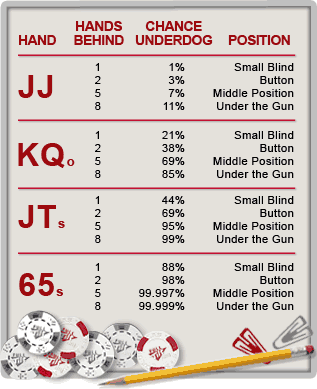

Super Welcome Bonus

Open a new account today at Sky Poker and enter promo code 'POKER' and you will automatically get a £5 No Deposit Bonus and entered into 2x£2500 New Player Freerolls
Check the site for details.